
High income, no savings? Where the money actually goes
Two good salaries, yet nothing left by month-end? See how much of your household income is really free and where lifestyle creep comes from.
By Rafał Prokopiak9 min read
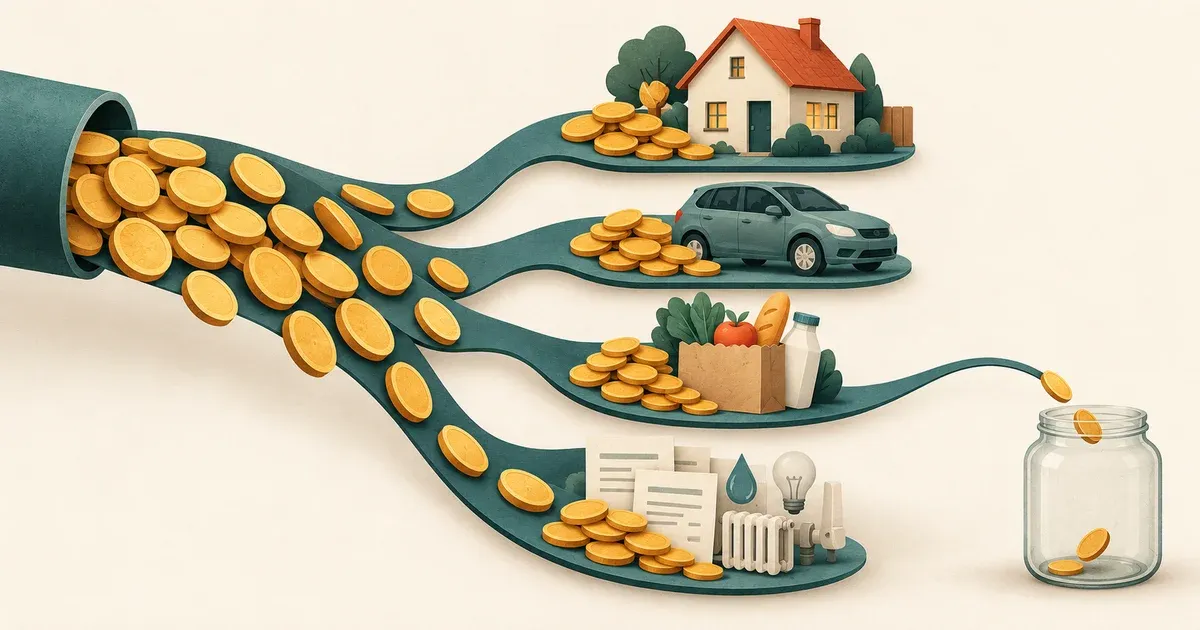
“We earn more than we ever have, and we still don’t know where it goes.” Two salaries, $9,300 a month take-home, and by the 26th the checking account is at zero while the credit card carries the rest. If the end of the year brings you a raise or a bonus, this is the right moment to understand why the last raises left no trace in your savings. You will leave with one number, your margin, and four steps that can lift it from a few percent to fifteen within six months.
The situation: Alex and Jamie, $9,300 take-home
Alex and Jamie are an illustrative example built from common situations, not a real family. Alex is 34 and works in accounting at a large company; Jamie is 36 and manages a shift at a distribution center. Both are salaried, and they have a four-year-old son. Two years ago they brought home $7,500 a month together and saved about $700. Then came two raises and a promotion for Alex: today it is $9,300, about $5,300 and $4,000.
Within a year, several things changed, each one reasonable on its own. They moved from a two-bedroom to a three-bedroom with a bigger mortgage. The old, paid-off car was replaced by a new one with a car loan, “because with a kid it has to be reliable”. Takeout went from one evening a week to three, two gym memberships and six subscriptions joined the budget, along with zero-interest plans for a phone, a couch and a robot vacuum.
A few months later none of it felt new. It was the new normal. They earn $1,800 more than two years ago and save less than back then, which means almost nothing. Both paychecks land on the 10th, and around the 26th the groceries go on the credit card. There is no frightening debt. There is a constant feeling that money slips through their fingers.
The diagnosis: where $9,300 disappears
The first step is to lay out one normal month in a few big groups, from both accounts together. No 40 categories, no judgment. This is Alex and Jamie’s month:
| Item | Per month |
|---|---|
| Take-home pay (two salaries) | $9,300 |
| Housing: mortgage, property tax, utilities | $2,500 |
| Car: loan payment, gas, insurance | $1,100 |
| Child: daycare and activities | $1,500 |
| Living: groceries, takeout, going out, gyms, subscriptions | $3,600 |
| Installment plans (phone, couch, robot vacuum) | $250 |
| Left over (margin) | $350 |
Out of $9,300, $350 is left, about 4% of income. That margin will not survive new tires, a wedding gift or a month when one of you is out sick without pay. Each of those goes on the card.
Notice that nothing in this table looks crazy. A home, a car, daycare: these are reasonable costs for a family with a small child. The problem isn’t one line; it is the total that nobody had added up.
Lifestyle creep in practice
Alex and Jamie did not make one bad decision. They made a few small ones that quietly turned into fixed costs:
| Upgrade | Two years ago | Today | Difference |
|---|---|---|---|
| Car: paid off vs. new on a loan | $300 | $1,100 | +$800 |
| Takeout: once vs. three times a week | $250 | $850 | +$600 |
| Two gyms and 6 subscriptions | $100 | $350 | +$250 |
Together that is $1,650 a month, more than twice what they ever saved. None of these things is bad in itself. The problem is that none was a decision made with numbers in hand. Each felt small next to the new paycheck. That is how lifestyle creep works: not as one big purchase but as a series of sensible-looking upgrades.
Two paychecks, two accounts, no picture
In many homes there is one more reason this slips by. Alex sees one account, Jamie sees another. The mortgage and daycare come out of Alex’s; the car, groceries and takeout come out of Jamie’s. Each account on its own looks roughly fine, and nobody sees the whole month.
That is why the first step is one table for the whole household, like the one above. You don’t have to merge accounts or justify every coffee. Once a month, add up the spending from both accounts in the same five groups and look at it together.
What changes: income is not the same as free money
There is one rule: margin matters, not income. Margin is take-home pay minus living costs and debt payments. It is the only part of your money you can actually save, give or use for surprises. An income of $9,300 with a 4% margin buys less peace than an income of $7,500 with a 15% margin.
In The Psychology of Money, Morgan Housel writes that wealth is what you don’t see: the cars not purchased and the money not spent. A high income is visible right away, in the car and the home. Savings only become visible when you need them. Housel also stresses that how much you save depends less on how much you earn than on how much your spending grows along with it.
In practice the rule means three switches:
- One picture for the whole household. Once a month, spending from both accounts goes into one table. You work out margin for the home, not for each of you separately.
- One upgrade goes back on the table. You don’t have to give up everything. You pick the one that brings the least joy for its cost.
- Saving comes first. The savings amount leaves your account automatically on payday, not “from whatever is left”, because with lifestyle creep the same thing is always left: almost nothing.
The target is a margin of at least 15%. Below 5%, every breakdown wrecks the month; between 5 and 15% it is tight but you can breathe.
After 6 months
Alex and Jamie did not change jobs, homes or cars. The car loan runs for three more years, and they chose to keep it. Instead, they did three things: cut takeout to one evening a week, kept one gym membership instead of two and canceled three of the six subscriptions. After four months the phone plan was paid off. Finally, they set up an automatic transfer of $900 to a shared savings account on payday.
| Item | Before | After 6 months |
|---|---|---|
| Take-home pay | $9,300 | $9,300 |
| Housing | $2,500 | $2,500 |
| Car | $1,100 | $1,100 |
| Child | $1,500 | $1,500 |
| Living | $3,600 | $2,700 |
| Installment plans | $250 | $100 |
| Margin | $350 (4%) | $1,400 (15%) |
| of which saved automatically | $0 | $900 |
Same income, and the margin is four times bigger. After half a year they have $5,400 in savings, and the 26th is no longer the day of opening the banking app with a knot in the stomach. The remaining $500 of margin stays as room for surprises instead of disappearing right away.
The most important change is not in the table, though. Alex and Jamie know what their life costs, and every next upgrade can now be planned together instead of discovered on a statement.
What about the next raise
The end of the year is the season of reviews and bonuses, so it is worth having a rule before the money arrives. A simple, fair one: half of every raise goes to margin, half to living. If one of you gets a raise worth $600 a month after taxes, then from the first month $300 is added to the automatic transfer and $300 is yours to spend on purpose.
This rule doesn’t take the joy out of a raise; it just keeps the whole raise from becoming new fixed costs. Treat a bonus the same way, only once: before it arrives, decide which part goes to the buffer and which to something enjoyable. With a 4% margin, the buffer should get the bigger part.
Work out your own margin: enter your household’s combined take-home pay, put housing, car, childcare and everyday spending under “Living”, and put installment plans and card payments under “Loan and debt payments”. You can count a mortgage under housing; the margin result stays the same.
The 5 buckets test: how much margin do you have?
Enter rough monthly amounts.
What to do this week
- Check the last 3 months (20 min). Open the statements from both accounts and add up what came in and what went out. One number for the whole household, not one per account.
- List the fixed costs added in the last 12 months (15 min). New payment plans, a car loan, subscriptions, a pricier home, memberships. Write the monthly amount next to each and add them up.
- Decide which upgrade stays (10 min). For each item on the list, ask one question: does it bring joy worth its monthly cost? Keep one on purpose, and cancel or shrink another.
- Set up an automatic transfer on payday (10 min). To a shared savings account, right after the paychecks land. Ten percent of take-home pay is enough to start; raise it as your margin grows.
There is treasure to be desired and oil in the dwelling of the wise; but a foolish man spendeth it up.
It is wisdom older than economics, and it says exactly what Housel does: savings don’t come from a high income, they come from part of the income not being spent.
Keeping it going in finanse.app
In finanse.app you add both partners’ accounts to one shared project and every expense lands in a category, so after a month you see in one place what your home, your car, your child and everyday life really cost. Your margin stops being a guess pieced together from two banking apps and becomes one number you both see.
Frequently asked questions
What percentage of my income should I save?
Start with 10% of take-home pay, moved automatically on payday. The longer-term goal is a margin of at least 15% after living costs and debt payments; saving, giving and surprises all come out of that margin.
Will earning more fix the problem?
Only if your fixed costs don't grow with it. If every raise turns into a new payment, a bigger home or pricier habits, your margin stays the same, just at a higher level.
How do we budget with two incomes and separate accounts?
Once a month, add up the spending from both accounts in the same few groups and compare it with your combined income. Margin counts for the whole household, not for each account on its own.
What is lifestyle creep?
It is when spending rises together with income, so after a raise nothing more is left than before. It rarely comes as one big purchase; it is a handful of small upgrades that become fixed costs within a few months.
See your cashflow in black and white
finanse.app shows where your money really goes — no spreadsheets, no manual math.
Try finanse.app